
How to price a tour package: cost, markup, and the margin you actually keep
Markup and margin are not the same number, and the difference is where agencies quietly lose money. A worked example with real figures, plus the rule for setting a target margin per destination.
Every agency prices packages. Very few price them the same way twice, and almost none can say, on the day the quote goes out, what margin is inside it. This is the method — with a worked example you can copy.
Step 1: build the cost, line by line
Start from what you will actually pay suppliers, per line, not from "what this usually sells for":
- Hotels: net rate × rooms × nights, per hotel
- Transfers: per segment, per vehicle
- Activities and entry tickets: per person
- Flights or trains, if you are booking them
- Visa fees, insurance, guide days
Write down the currency and the date of each rate. Rates change; a quote built on last season's hotel price is the most common way to lose margin without noticing.
Example. Bali, 5 nights, 2 pax, mid-range hotels with pool: hotels ₹68,000, transfers ₹14,000, activities ₹22,000, insurance and misc ₹16,000. Total cost: ₹1,20,000.
Step 2: decide markup per line, not on the total
A single percentage on the total feels simple, but it hides which lines carry your risk. Hotels you negotiated hard on can take more; a fixed-price entry ticket cannot. A reasonable starting shape:
- Hotels: 15–20%
- Transfers: 10–15%
- Activities/tickets: 8–12%
- Pass-throughs (visa fees, insurance): 0–5%
Step 3: know the difference between markup and margin
This is where money leaks.
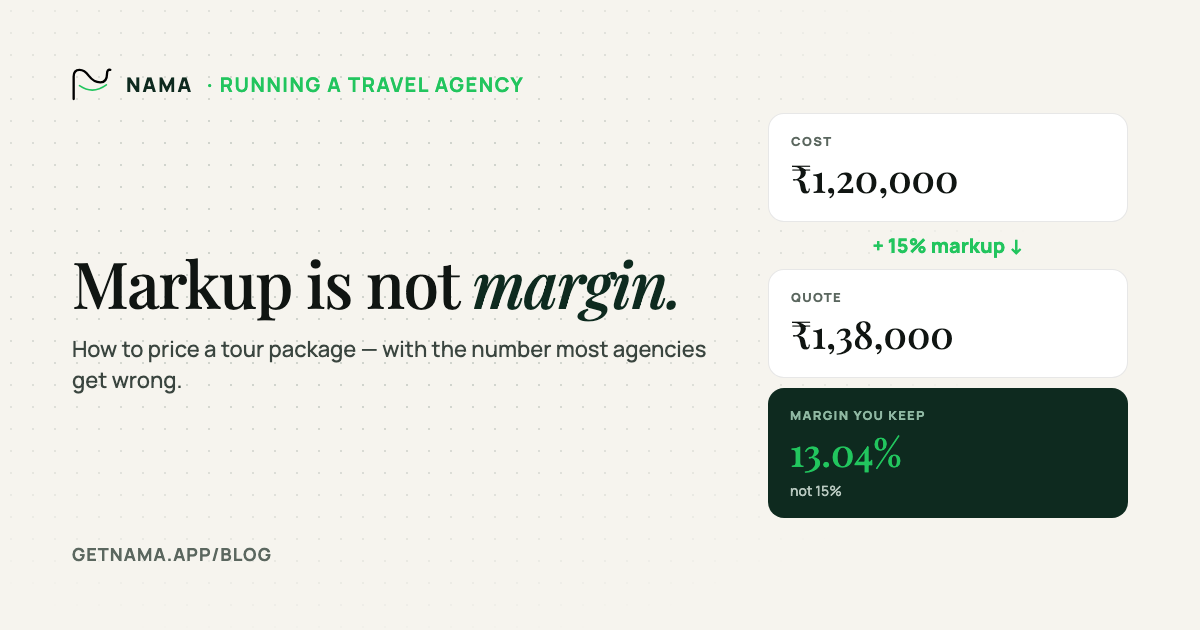
- Markup is what you add to cost. 15% markup on ₹1,20,000 = ₹18,000 → quote ₹1,38,000.
- Margin is what that ₹18,000 is as a share of the sell price: 18,000 ÷ 1,38,000 = 13.04%.
So a "15% markup" package is a 13% margin package. If you set your target as a margin, the markup you need is higher than the number in your head: to keep 15%, you need to mark up about 17.6%.
The formula: markup needed = margin ÷ (1 − margin). For 20% margin, mark up 25%.
Step 4: sanity-check against the market
Two questions before the quote goes out:
- What is the per-person price? ₹1,38,000 ÷ 2 = ₹69,000 per pax. Does that sit where you expect for this destination and hotel tier?
- What would it cost the customer to book the same hotels directly? If your price is well above that, the margin is real only if the service is visibly worth it.
Step 5: lock it, then stop touching it
Once the quote is sent, the margin is fixed. Every "small change" — an upgraded room, an extra transfer added free — comes out of the margin unless it is repriced. Most agencies lose more margin after the quote than in it.
Doing this every time
By hand, this is a spreadsheet you rebuild for each enquiry, and the markup-vs-margin mistake is easy to make at 6pm. The reason to keep supplier rates in software is that steps 1–3 happen automatically: cost and markup sit on each line, the sell price updates as you edit, and the margin is visible before you send.
If you want to see the numbers for your own package, the free margin calculator takes cost, pax and a target margin and returns the sell price, per-pax price and the margin you actually keep — no account needed.
Frequently asked questions
- What is a good margin on a tour package?
- Domestic packages in India commonly land between 10% and 18% net margin; international honeymoon and family packages 12% to 20%; group departures lower per head but higher in total. The right number is the one that covers your cost of selling plus the risk you carry.
- Is markup the same as margin?
- No. Markup is added to cost; margin is measured against the sell price. A 15% markup on ₹1,20,000 gives a ₹1,38,000 quote — which is a 13.04% margin, not 15%.
- Should I add margin per line or on the total?
- Per line. Hotels, transfers and activities carry different risk and different negotiating room; a single markup on the total hides which lines are subsidising which.