
Travel CRM vs travel operating system: which one does your agency actually need?
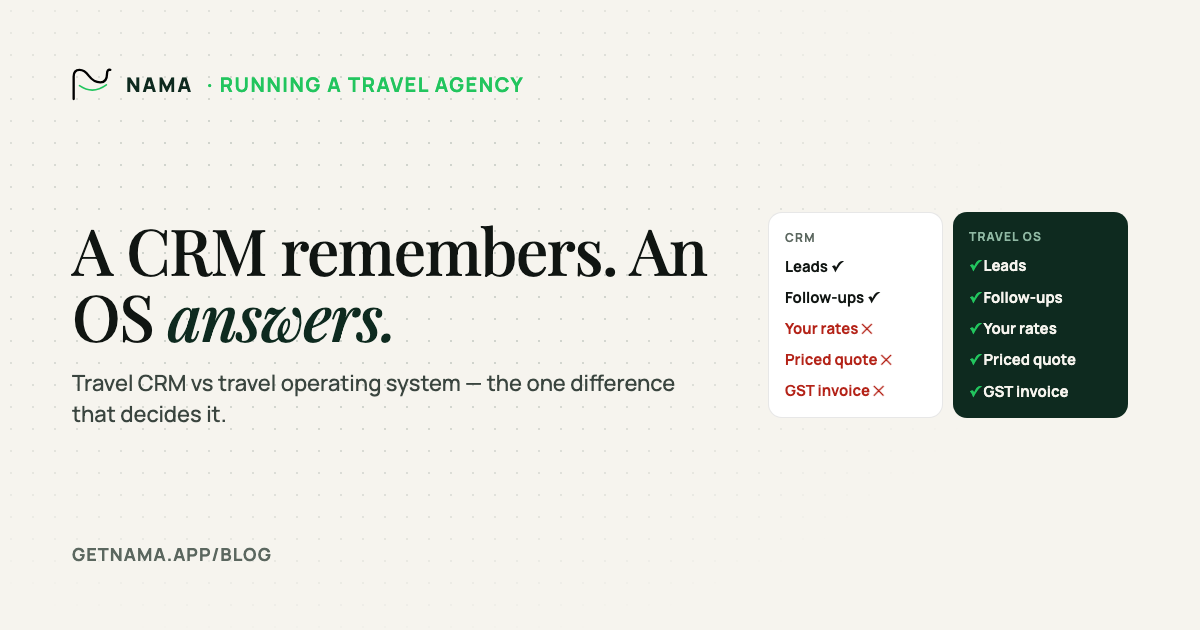
A CRM remembers who asked. An operating system answers them. The difference decides whether your rates, your quote and your invoice are one record or three — and it is the question to settle before you buy either.
"We need a CRM" is the sentence most travel agencies say when what they mean is "we are losing track of enquiries and quoting too slowly." Those are two different problems, and only one of them is solved by a CRM. This is the difference, and a two-minute test for which one you need.
What a CRM is
A CRM — customer relationship management — is a system of record for people and conversations. Contacts, leads, a pipeline with stages, notes, reminders, follow-up tasks, and reports on how many leads turned into bookings. Zoho, Salesforce, HubSpot, and the travel-specific CRMs all live here.
A good CRM answers: Who asked? What did we say? When should we chase them?
What a CRM does not know is what a 7-night Rajasthan trip for two costs you this September. The rates are not in it. The quote is built somewhere else — a spreadsheet, a Word template, a supplier's PDF — and then attached to the contact as a file.
What a travel operating system is
A travel operating system holds the work, not just the conversation. Your supplier rates with cost and markup. The itinerary built from them, priced as you build it. The booking that the accepted quote becomes. The vouchers. The GST invoice — CGST/SGST or IGST by place of supply — generated from that booking. And, yes, the leads and follow-ups, because the enquiry is where the record starts.
It answers a different question: What is the correct price for this, right now, and can I send it before the other agency does?
The one difference that matters
Put side by side:
| Travel CRM | Travel operating system | |
|---|---|---|
| Leads, pipeline, follow-ups | Yes | Yes |
| Your supplier rates, with cost and markup | No | Yes |
| Quote built from those rates, price updates as you edit | No — quote is an attachment | Yes |
| Margin visible before you send | No | Yes |
| Booking created from the accepted quote | Rarely | Yes |
| GST invoice generated from the booking | No | Yes |
| Vouchers, departures, seats | No | Yes |
| What it is good at | Remembering and chasing | Answering correctly, fast |
Everything in the right-hand column flows from one fact: the rates are in the system. Once they are, the quote, the booking and the invoice can be one record. Until they are, each is a separate document that someone re-types.
When a CRM is enough
Honestly: when quoting is not your bottleneck. If you sell a small fixed catalogue at fixed prices, or you are a one-person agency whose rates genuinely live in your head and you answer in minutes anyway, a CRM plus a calendar is fine. Do not buy more.
When it is not
- A correct quote takes hours, and enquiries go to competitors too.
- Two people quote the same hotel at two different prices in the same week.
- You know your margin at month end, not when you send the quote.
- Every booking is re-typed for the supplier and again for the invoice.
- GST on the 1st means a person deciding, invoice by invoice, whether it was inter-state.
If two of those are true, the CRM is not the problem — the missing rate base is, and no amount of pipeline reporting fixes it.
The two-minute test
Open whatever you use today and ask it: "What does 3 nights at our Udaipur heritage hotel cost us in October, and what do we sell it at?"
If the answer is in the software, you have an operating system. If the answer is in a PDF, a WhatsApp thread or a colleague, you have a CRM — and your quote is still built by hand, however good the pipeline looks.
Where NAMA sits
NAMA is the right-hand column. It has the CRM inside it — leads from your web form, storefront and email in one inbox, pipeline, follow-ups, EKLA drafting the reply for a person to send — and it holds your rates, builds the quote from them, and turns the accepted quote into the booking and the GST invoice. The free margin calculator is the smallest possible version of the rate-base idea: cost and target margin in, sell price out, no account needed.
If you only need the left-hand column, a CRM will cost you less. If you are losing bookings between the enquiry and the quote, the column you need is the right one.
Frequently asked questions
- Is NAMA a CRM?
- It contains one — leads, pipeline, follow-ups, contacts — but a CRM is a third of it. NAMA also holds your supplier rates and builds the quote, the booking and the GST invoice from the same record, which a CRM does not.
- Can I keep my CRM and add NAMA?
- You can, but you will re-type every won lead into NAMA to quote it. Most agencies move the pipeline across once the rates are in, because the lead and the quote want to be one record.
- What is the quickest way to tell which one I need?
- Ask where your prices live. If they live in the software, you have an operating system. If they live in PDFs and one person's head and the software just tracks the conversation, you have a CRM — and the quote is still built by hand.