
Spreadsheets vs a travel agency OS: what breaks at 50 enquiries a week
Excel and WhatsApp run most agencies fine — until they don't. Here is the exact point where they fail, and what changes when the rates, the leads and the invoices live in one place.
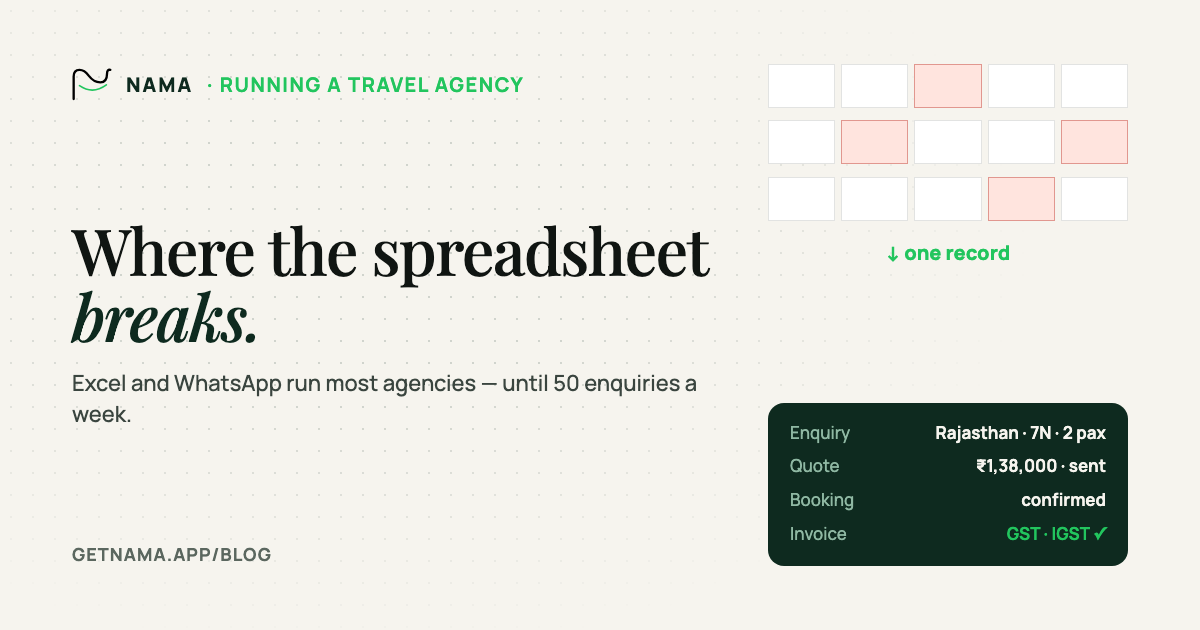
Most travel agencies in India run on three things: a WhatsApp number, an Excel sheet and one senior person who knows the rates. It works. It works for years. Then enquiries go from ten a week to fifty, and the same three things start costing you bookings.
This is not an argument that spreadsheets are bad. It is a description of the exact point where they break, so you can see whether you are there yet.
What a spreadsheet is good at
A spreadsheet is a perfect ledger. If the job is "record what happened", nothing beats it. Bookings this month, payments received, supplier dues — Excel handles all of it, and everyone on the team already knows how to use it.
The trouble starts when the spreadsheet stops being a record and becomes the tool you work in.
The five places it breaks
1. The quote takes an afternoon. A customer asks for seven nights in Rajasthan for two. To answer, someone opens the hotel rate PDF, checks the transfer rates in a WhatsApp thread with the transport vendor, remembers (or doesn't) that the Jaipur hotel changed its September price, adds a markup in their head, and types it into a Word template. Two to three hours. The customer sent the same message to three agencies. The first correct number usually wins.
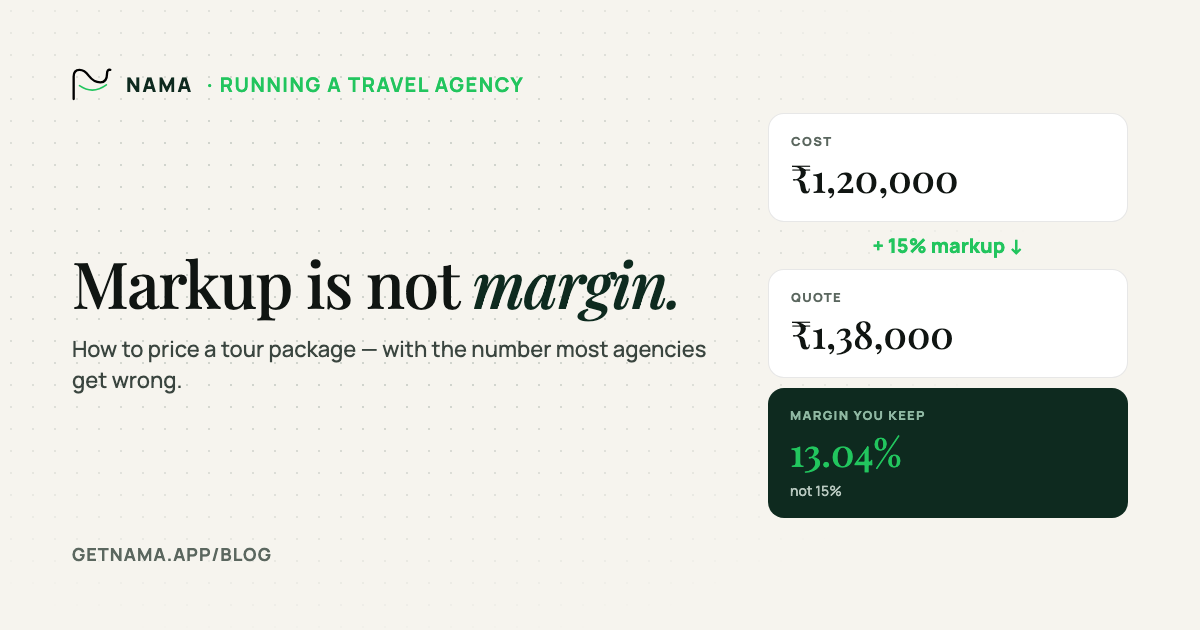
2. Nobody knows the real margin. The markup was applied line by line, by hand, by different people on different days. At month end you know what was billed and what was paid to suppliers, so you know the margin after the fact. You did not know it when you sent the quote.
3. Follow-ups depend on memory. The enquiry lives in one person's WhatsApp. If they are on leave, the lead waits. If they forget, the lead goes cold. There is no list of "quotes sent, no reply for three days" because the quote is a PDF in a chat, not a record with a status.
4. Every handoff is a re-type. Sales types the itinerary. Operations re-types it for the supplier. Accounts re-types it for the invoice. Three copies, three chances for the hotel name, the dates or the pax count to drift.
5. GST gets done on the 1st, painfully. Which invoices were inter-state? Was that one a credit note? The spreadsheet does not know place of supply; a person has to.
What "one place" actually means
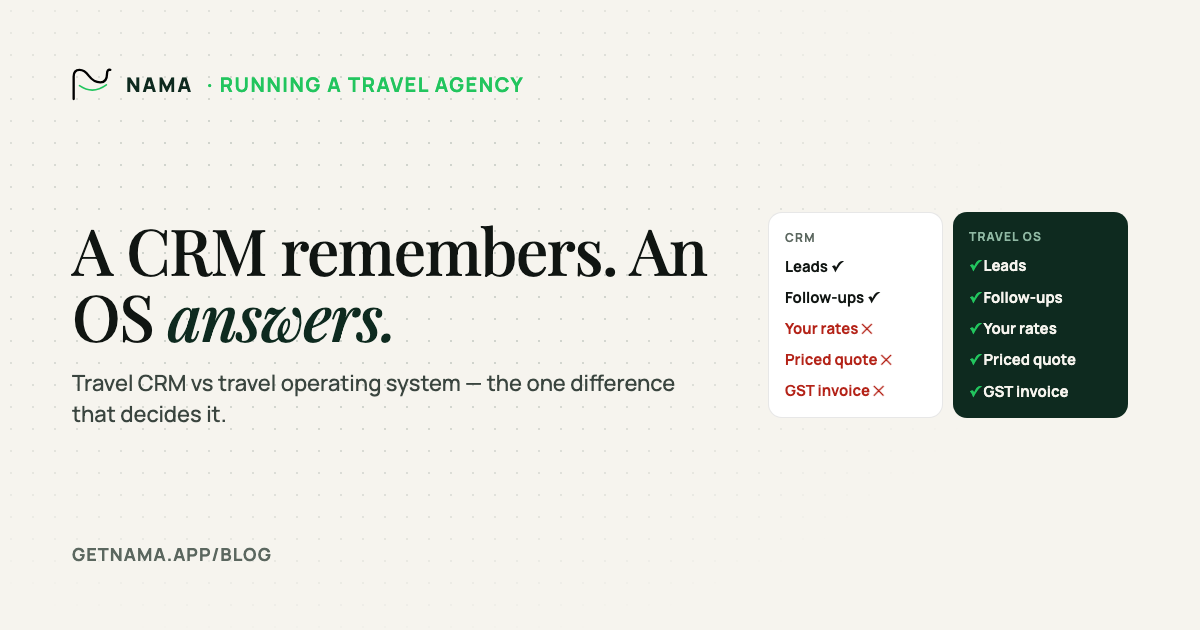
A travel agency operating system is not a fancier spreadsheet. The difference is that the rates, the leads, the quotes, the bookings and the invoices are one record that moves through stages, instead of five documents that describe the same trip.
Concretely, in NAMA:
- Your supplier rates go in once — hotels, transfers, activities, with your cost and your markup on each. This is the step that fixes everything downstream.
- A quote is built from those rates, so the price updates as you add nights or change the hotel, and the margin is already inside it. It goes out as a branded PDF or a share link.
- Every enquiry is a lead with a status, from a web form, your storefront or email. "Quoted, no reply in 3 days" is a filter, not a memory.
- The invoice is generated from the booking — CGST/SGST or IGST chosen by place of supply, credit and debit notes tied to the original. Nothing re-typed.
- Ask questions in plain English — "how many Kerala enquiries last month, by agent?" — instead of building a pivot table.
How to tell if you're at the breaking point
Ask three questions:
- How long does a correct quote take, from message to PDF? If the answer is measured in hours, you are paying for it in lost bookings.
- Do you know the margin on a quote before you send it?
- If your best salesperson left tomorrow, would the rates leave with them?
If two of the three answers hurt, the spreadsheet has become the bottleneck.
Where to start
Do not migrate everything. Move the rates first. Put your top twenty hotels and your transfer rates into one place, quote the next ten enquiries from there, and time it. That single change is what shortens the quote; everything else follows from it.
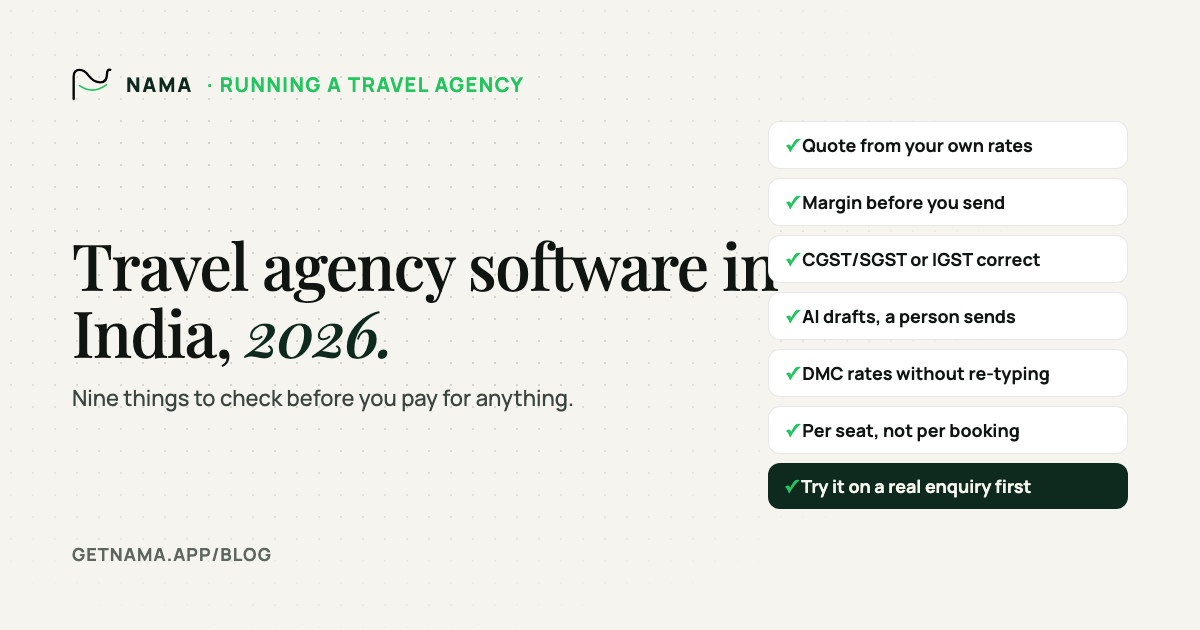
NAMA's Compass plan is free for two users with no card required, and there are four free tools that need no account at all if you want to feel the difference on one enquiry first.
Frequently asked questions
- Do I need software if my agency is small?
- Not at 5 enquiries a week. At 50, the cost of the spreadsheet is the bookings you lose to whoever quotes first. NAMA's Compass plan is free for 2 users, so the switch costs nothing to try.
- What's the first thing to move off Excel?
- Your supplier rates. Every other problem — slow quotes, wrong prices, unknown margin — comes from the rates living in PDFs and people's heads.
- Can I keep using WhatsApp with my customers?
- Yes. The point is not to replace WhatsApp; it is that the enquiry, the quote and the invoice should be one record instead of three re-typed copies.